You choose the model
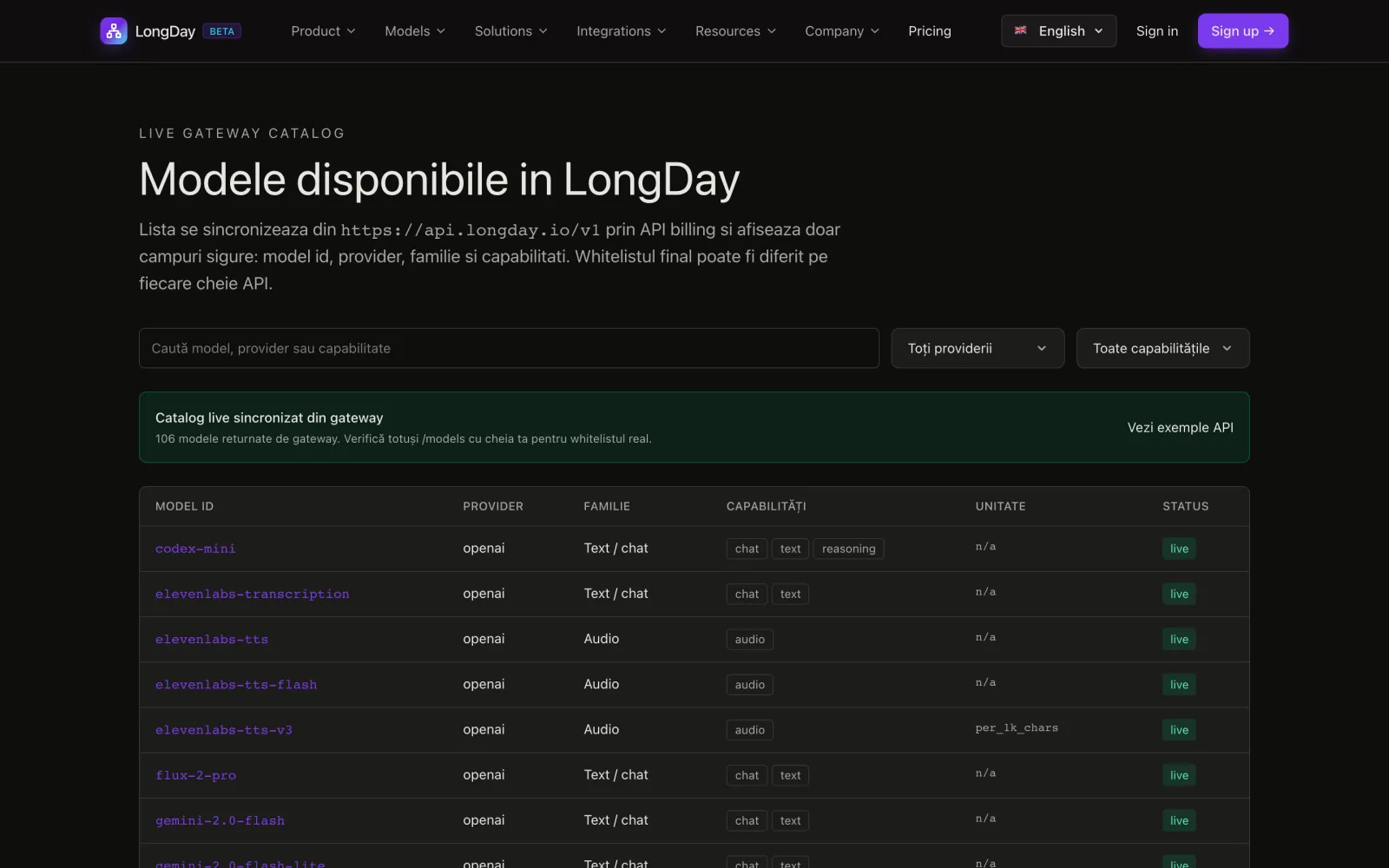
You consult the current catalogue and the capabilities required by the application.
API for AI models Platform
API access to AI models through a common interface. LongDay is the technical layer for teams that build products and need to connect models to their own applications.
LongDay
You consult the current catalogue and the capabilities required by the application.
You integrate access into the application, with keys kept on the server.
You manage consumption and choose the right model for the task.
A single integration point for products that use language models.
Evaluation of models suited to a task before scaling the implementation.
A technical component that can support custom agents and workflows.
The available models, rates and limits are consulted in the LongDay platform at the time of use.
LongDay in detail
LongDay is a gateway: one key and one address instead of a separate account with each model provider. The endpoint is OpenAI-compatible, which in practice means that in an existing application you change the baseURL and the key, and the rest of the code remains untouched — including in LangChain, LlamaIndex or Vercel AI SDK.
The reason it exists and is not just a proxy: a company from Moldova that wants to use AI models runs into payment. LongDay keeps the wallet in dollars, but issues an invoice in lei through e-Factura, with the official BNM exchange rate taken on the day of the transaction. The contract is signed in Romanian.
The price is formed from a single rule, verifiable in code: the provider's actual cost plus 70%, identical across all five plans. There are no more expensive plans with cheaper tokens, and no the other way round. The amount is rounded up to the micro-cent level.
The catalogue queried today, 6 September 2026, has 107 active models. 78 do chat and text, 48 have declared reasoning capability, 17 audio, 7 image, 7 realtime, 3 embeddings, 2 video. Issued keys carry the prefix sk-longday-. The catalogue is served publicly, without authentication, at longday.io/api/public/models — you can check it before opening an account.
The gateway is https://api.longday.io/v1. In Node, change baseURL; in Python, base_url. The own documentation lists the tested libraries: OpenAI Node, OpenAI Python, LangChain JS and Python, LlamaIndex, Vercel AI SDK. It also works from any no-code tool that can send an Authorization: Bearer header.
Each key can have its own spending cap, reset cycle at 1, 7, 30 or 90 days and an allowlist of models. This means that an experimental agent and a production workflow can sit on the same account without the first being able to consume the budget of the second.
The wallet is in dollars; top-ups are made through Stripe, with amounts between 5 and 250 dollars. Conversion into lei uses the official BNM rate of the day, read directly from the bank's XML, with a local fallback if the service does not respond within five seconds. The credit policy is absolute 1:1: any amount paid becomes exactly the same amount of credit, with no bonuses and without passing Stripe's fee on to the client.
Free (no subscription, cap of 10 requests per minute), Starter $5/month, Pro $20/month, Business $80/month, Enterprise negotiable. Each paid plan includes monthly credit equal to the subscription. The margin is 70% across all five. Business and Enterprise have monthly e-Factura.
Data and operation
From exploration to implementation
A minute with the public endpoint. If the model your application relies on is not there, the rest of the discussion is pointless — and it is better to find out before integration than after.
The key gets a budget and, if applicable, a whitelist of models. For a pilot, a small cap is a feature, not a limitation: it turns a bug into a predictable bill.
A model good at drafting is not automatically good at structured extraction. The same examples, run through several models from the same account and the same key, give a comparison you can defend. The cost of the comparison is visible in the consumption panel.
For a company in Moldova, topping up via Stripe and the invoice in lei are two separate things. Here we establish which plan is needed for the monthly e-Factura and which documents the accounting department requires.
We queried the public catalogue on 6 September 2026: 107 models, all marked live. The GPT-5 family is broadly covered, from nano to pro, including the codex variants and the four 5.6 versions; there are o1/o3/o4-mini, the full Gemini line (2.0, 2.5, 3, 3.1 flash and flash-lite), Gemma 3 and 4, image (gpt-image-1/1.5/2, flux-2-pro, gemini flash image, mai-image-25), video (sora-2), audio and realtime (gpt-realtime up to 2.1, transcription, elevenlabs-tts in three variants), embeddings and deepseek-v4-flash. One thing we need to say directly: in the live catalogue there is no Anthropic Claude model, although our internal README and presentation pages still promise "Anthropic Claude direct". Llama, Qwen, Mistral, Voyage and Cohere are also missing, although they appear in our document for crawlers. The public catalogue is the source of truth; those texts are out of date.
The provider’s actual cost plus 70%, rounded up to the micro-cent. The same percentage across all five plans — there is no preferential token rate on the expensive plans. The rule is an execution-time checked invariant: if any code path tried to go below 70%, it throws an error instead of issuing an invoice. The paid plan does not make your tokens cheaper; it gives you a monthly credit equal to the subscription, e-Invoice on Business and Enterprise, and support tiers.
The surface is OpenAI-compatible, served by a LiteLLM proxy at https://api.longday.io/v1. In practice: in Node you change baseURL in the OpenAI constructor, in Python base_url, and the rest of the code remains identical. The in-house documentation lists as tested OpenAI Node, OpenAI Python, LangChain JS, LangChain Python, LlamaIndex and Vercel AI SDK. It also works from no-code tools that can send a Bearer header.
The Free plan is capped at 10 requests per minute; the other four plans do not have a plan cap defined in code and are limited by the key budget. Top-ups accept between 5 and 250 dollars per transaction. Each key can have its own budget with a cycle of 1, 7, 30 or 90 days and a model allowlist. Some models have their own upstream limits noted in the catalogue — gpt-image-2 at 10 requests per minute, gpt-realtime-2.1 at a quota of 15 TPM.
A document, not a measurement — and it is important to know the difference before relying on the figure. Our SLA page publishes five tiers, from 99,0% on Free to 99,99% on Enterprise, and says that uptime is calculated monthly from status.longday.io. That subdomain does not exist: it has no DNS record and does not respond. In code there is no availability collector — neither a metrics endpoint nor external monitoring; both are unstarted tasks in our own backlog. The status page that does exist makes three real-time probes and does not keep history, so it cannot produce a monthly percentage. The 99,9% figure shown on the homepage is a written contractual commitment, not an observation, and the product self-labels as BETA in the header of the same page. Until the monitor exists, treat the percentage as a contract clause with compensation credit, not as proven performance.
Here we need to be exact, because there is a difference between what is designed and what is built. Currency conversion is real and works: the official NBM rate is read from the bank’s XML for the respective day, with a local fallback if the service does not respond within five seconds. The client that submits the invoice to the Fiscal Service is, however, still a skeleton — a wrapper over fetch, with its own comment saying that the real implementation, the one that loads the company’s PKCS#12 certificate and signs each request, is still to come. Until then the e-Invoice part is handled with accounting, not automatically from the platform.
No. It is an access and billing layer over other companies’ models. It should not be confused with Grai, which is our Romanian voice research project and has no technical connection with the gateway.
Illustrative example
A use case, without client data or attributed commercial results.
A team already has an integration that works on the OpenAI SDK, paid with the personal card of one of the associates, without a document that can be entered into accounting.
Change baseURL to https://api.longday.io/v1 and the key. A separate production key is issued, with a monthly limit and an allowlist only for the models actually used, so a faulty cycle cannot consume the whole month’s budget. Top-ups are made through Stripe in dollars.
The code remains identical — only two configuration values change. Consumption is visible per key, and the Business plan includes monthly e-Invoice. The per-token price is the provider’s actual one plus 70%, the same as on the Free plan.
What is required:The model used must exist in the live catalogue — this is checked in advance at longday.io/api/public/models. If the application depends on an Anthropic Claude model, it is not available today through the gateway.
Collaboration possibilities
Connecting authorised sources, organising information and reviewing actions by the team, with separate access by role.
We define a pilot around a real process: users, data, integrations, costs and acceptance criteria. Expansion follows after evaluating the result.
We establish the requirements for accessibility, hosting, data protection and interoperability. Any connection to AGE or STISC services requires validation of eligibility, access and approvals.
These are adaptation scenarios, not statements about existing contracts or partnerships. The proposed functions are confirmed within the project scope.
Discuss a pilotAn assistant connected to your business information, in the channels your customers actually write to.
PlatformGrai is our research direction for speech synthesis and for models adapted to the languages spoken here.
Research & developmentWorld Agent is a demonstrator for natural-language interaction with a visual scene.
Research demonstratorTell us about your process. Together we decide what is worth building, what we can connect, and how we check the result.