Download
It takes public orbital elements from CelesTrak and ephemerides published by constellation operators, with 2 hours of local memory — as long as the source cadence.
Orbital visualisation Public instrument
3D map of objects in orbit, with public CelesTrak data and ephemerides from constellation operators. Positions are propagated with SGP4, not received from the satellite — the application shows the age of the orbital elements and the estimated error in kilometres for each object.
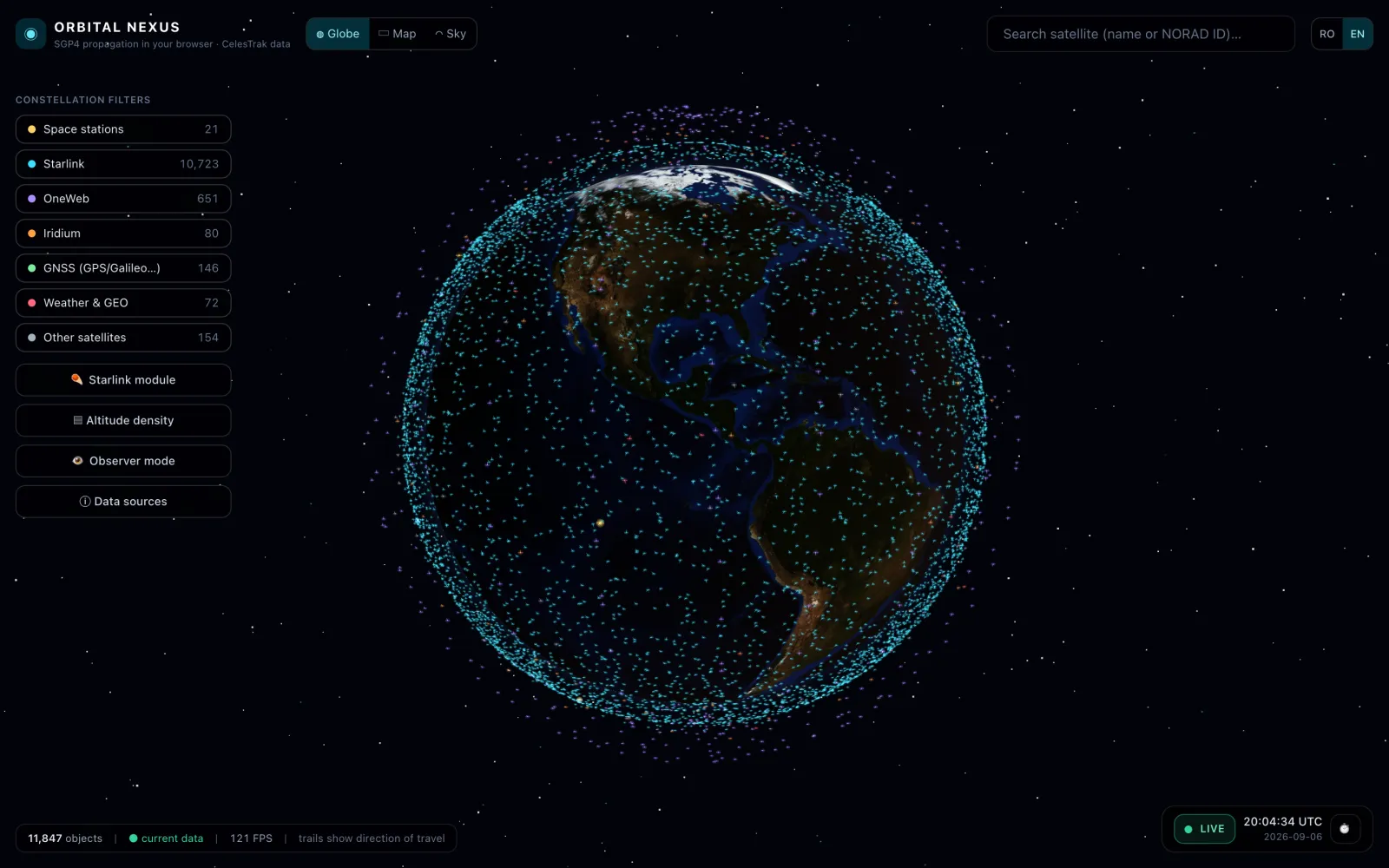
Orbital Nexus
It takes public orbital elements from CelesTrak and ephemerides published by constellation operators, with 2 hours of local memory — as long as the source cadence.
Runs the SGP4 model for the full catalogue, on a computation thread separate from the interface, and shows the age of the elements and the estimated error for each object.
Draws the result in WebGL — globe, map or the sky above you — and calculates when the next object visible to the naked eye passes.
When the space station passes over your location and from where it rises.
What an orbit looks like, why it passes at different times and what a re-entry means.
A catalogue of over eleven thousand objects, propagated and drawn without a rendering server.
The orbital data belong to CelesTrak, based on the US Space Force catalogue; the additional ephemerides belong to the constellation operators. Their policy requires attribution and forbids mass redistribution. Positions are calculated, not telemetry.
Collaboration possibilities
Analysis of satellite images and indicators for planning, environment or agriculture, with mention of the resolution, date and limits of each source.
We define a pilot around a real process: users, data, integrations, costs and acceptance criteria. Expansion follows after evaluating the result.
We establish the requirements for accessibility, hosting, data protection and interoperability. Any connection to AGE or STISC services requires validation of eligibility, access and approvals.
These are adaptation scenarios, not statements about existing contracts or partnerships. The proposed functions are confirmed within the project scope.
Discuss a pilotTell us about your process. Together we decide what is worth building, what we can connect, and how we check the result.