Robots and machinery Complete design, no unit built
An engineering dossier for a mortar printer, taken to the last position.
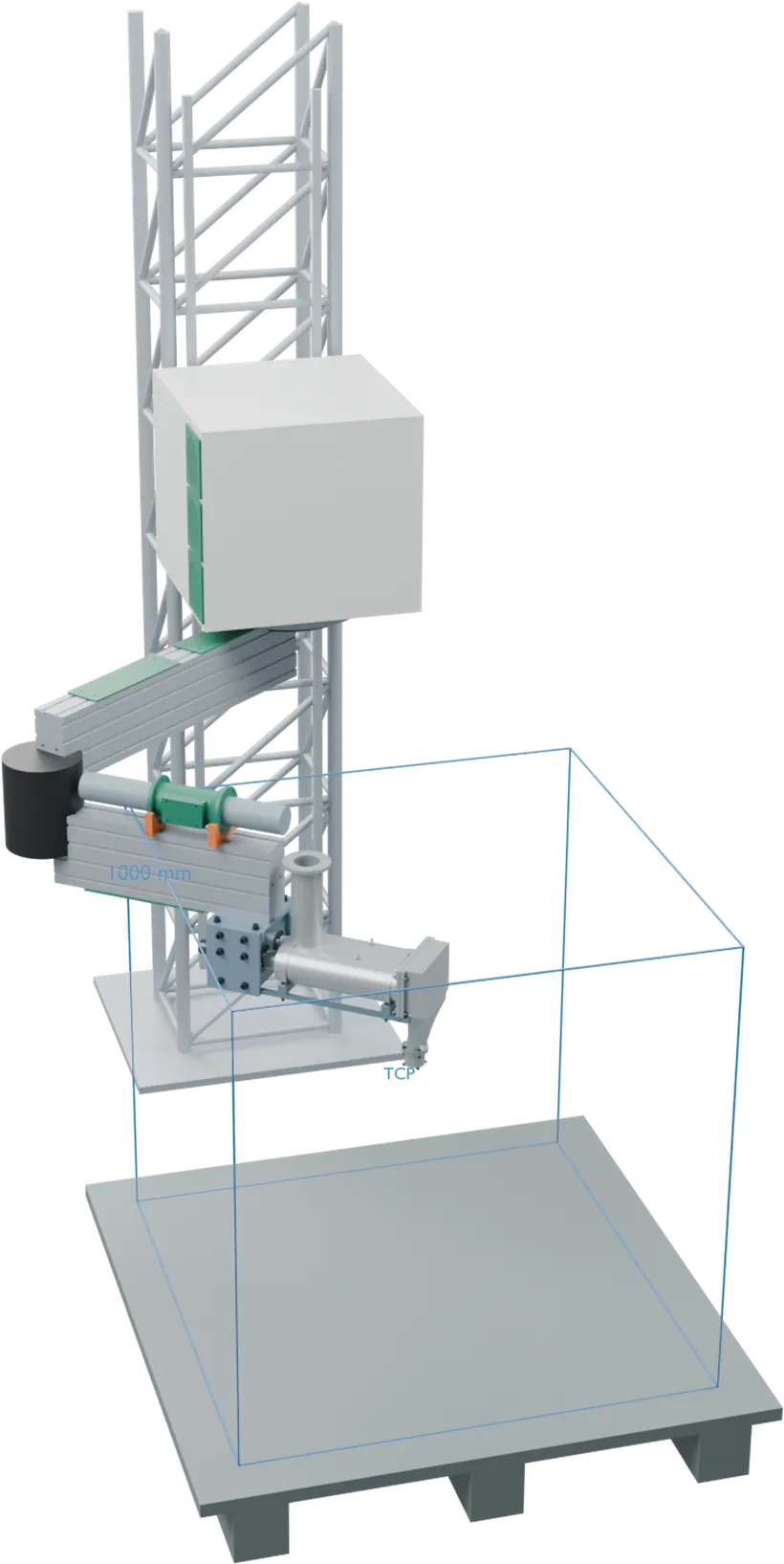
CP-CUBE-1 is a closed cell that deposits mortar layer by layer, for non-load-bearing objects of up to one cubic metre. It is fully designed — CAD, bill of materials, electrical scheme, safety architecture, requests for quotation — and it is not built. We publish the exact stage, not a promise.
Render from the current revision of the in-house project · the head and mount are not released for manufacture
MEGA CP-CUBE-1
From information to work done.
01
Dose
The 50 L batch mixer and progressive pump push premixed mortar through a 5 m DN25 hose. The qualified range in phase 1 is 0.7–6.0 L/min, although the pump goes up to 15.5 — the software and safety valve do not automatically authorise the full range.
02
Position
The bed remains fixed; only the head moves. X on the gantry, Y1 and Y2 synchronised with independent feedback, Z on the vertical ram. A 1.0 mm deviation between Y1 and Y2 triggers a fault and requires re-homing.
03
Stops by itself
Safety does not pass through the motion controller. 24 of the 64 I/O points are on a separate safety controller, which acts directly on STO, on the brakes, and on pump inhibition.
Where it becomes useful.
Non-load-bearing prefabricated objects
The maximum envelope is 1000 × 1000 × 1000 mm, with aggregate of up to 2 mm in the mortar. Structural construction elements are explicitly outside this revision.
Urban furniture and hard-to-form shapes
Geometries that make formwork expensive: curves, voids, small series. The one-cubic-metre volume is chosen to fit in a workshop, not on a construction site.
A mortar qualification bench
The test path (`coupon`) is parametrised in code and checked digitally: it stays within the usable volume, reaches a height of one metre, and rejects invalid configurations. It is the tool with which the first printable mortar would be qualified.
We do not produce 3D printers. CP-CUBE-1 is designed, not built: six requests for quotation are prepared and none sent, and zero positions in the bill of materials have the status that would allow an order. The manufacturers named in the project are reference choices from a catalogue, not confirmed suppliers and not partners.
Collaboration possibilities
MEGA CP-CUBE-1, in the context of your organisation.
Design of machinery and mechanisms
The engineering file — parametric model, bill of materials, electrical diagram, safety architecture — taken to the point where a workshop can quote. Manufacturing and material trials are carried out in the workshop, not by us.
Private companies
We define a pilot around a real process: users, data, integrations, costs and acceptance criteria. Expansion follows after evaluating the result.
State institutions and companies
We establish the requirements for accessibility, hosting, data protection and interoperability. Any connection to AGE or STISC services requires validation of eligibility, access and approvals.
These are adaptation scenarios, not statements about existing contracts or partnerships. The proposed functions are confirmed within the project scope.