Load the real model
A custom MJCF parser reads the official robot descriptions from MuJoCo Menagerie, with their meshes: 35 STL files for G1, 16 OBJ files for Go2. These are not approximations drawn by us.
Robotic simulation Public demonstrator, with closed qualification gate
Two Unitree robots — G1 humanoid and Go2 quadruped — on Earth, the Moon and Mars, in the browser. The models and geometry are real, the movement on the page is a cinematic preview declared as such, and the physical proof is produced separately, with MuJoCo on the CPU. The qualification gate is red and says why.
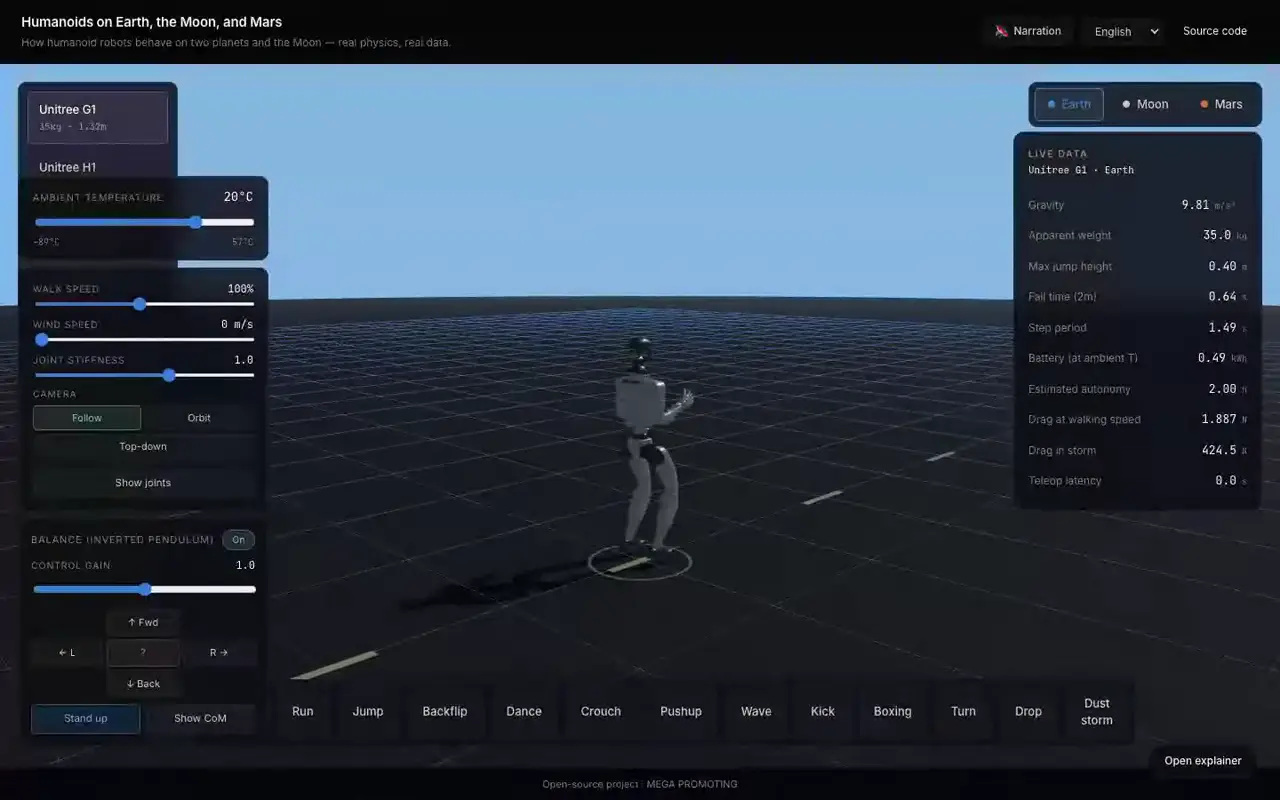
Humanoid Sim
A custom MJCF parser reads the official robot descriptions from MuJoCo Menagerie, with their meshes: 35 STL files for G1, 16 OBJ files for Go2. These are not approximations drawn by us.
The 15 actions in the internal register are all marked `cinematic`, zero `validated`. The register is a safety gate, not a label: an unvalidated action cannot be triggered from the interface.
The physical proof is produced outside the browser, with MuJoCo 3.10.0 on CPU: 6 scenarios, two runs each, with an identical SHA-256 fingerprint across runs. What does not pass the gate remains blocked.
The same fall, three worlds: 9,80665, 1,62 and 3,72076 m/s². In the measured proof, the first ground contact for G1 comes at 0,226 s on Earth, 0,366 s on Mars and 0,554 s on the Moon. The difference can be seen and shown with figures.
The project is the place where we built a gate that says "no" to the project itself. The same pattern — a command that exits with a non-zero code when the proof is missing — we carried further into the other works.
The Isaac Lab / PhysX scaffold exists in the repository and is configured to refuse to start without the proper NVIDIA/Linux environment, rather than produce results you cannot trust. No real run has taken place.
It is not a physics-grade simulator. In the web runtime, rigid body dynamics, contacts, actuator dynamics or synthetic sensors are not active, and the custom joint matrix says “Physics runtime web: absent”. Three physics libraries and URDF are installed in the project without being used — their presence in `package.json` does not mean support.
Collaboration possibilities
The engineering file — parametric model, bill of materials, electrical diagram, safety architecture — taken to the point where a workshop can quote. Manufacturing and material trials are carried out in the workshop, not by us.
We define a pilot around a real process: users, data, integrations, costs and acceptance criteria. Expansion follows after evaluating the result.
We establish the requirements for accessibility, hosting, data protection and interoperability. Any connection to AGE or STISC services requires validation of eligibility, access and approvals.
These are adaptation scenarios, not statements about existing contracts or partnerships. The proposed functions are confirmed within the project scope.
Discuss a pilotTell us about your process. Together we decide what is worth building, what we can connect, and how we check the result.